Compute Options: The Next Frontier for the AI Industry
Options give buyers and sellers of compute a flexible way to manage GPU price volatility. This guide walks through how covered calls and cash-secured puts work and how they can be used both insurance and an investment strategy.
As AI scales across industries at an unprecedented rate, the cost of compute has become a material line item on company balance sheets. True hedgers, such as frontier AI labs training large language models, and neoclouds powering AI-driven products, are all exposed to GPU rental price risks. This underlying variable is particularly volatile on high-demand chips like Nvidia's H100 and H200.
American Innovation Exchange LLC ("AI Exchange"), a subsidiary of Architect Financial Technologies Inc., intends to launch compute derivatives contracts starting with futures products. While futures will be the Exchange's initial offering, we believe compute options have the potential to be equally transformative for the U.S. AI industry. Sellers and buyers of compute won't only use options for insurance, but as an investment strategy. Below we explain what an option is and how firms can leverage options trading strategies to manage their operational costs in this nascent asset class.
Traditional Options Contracts
Options and futures contracts are derivatives products that help with risk management and price discovery when buying or selling a certain commodity. While a futures contract creates an obligation for both buyer and seller, an options contract gives the buyer the right, but not the obligation, to buy or sell an asset at a predetermined price before or on a specific expiration date. In exchange for this right, the buyer pays a premium to the seller upfront.
For the buyer, maximum loss is limited to the premium paid. For the seller, that premium represents their maximum gain, while their potential loss can be substantially greater.
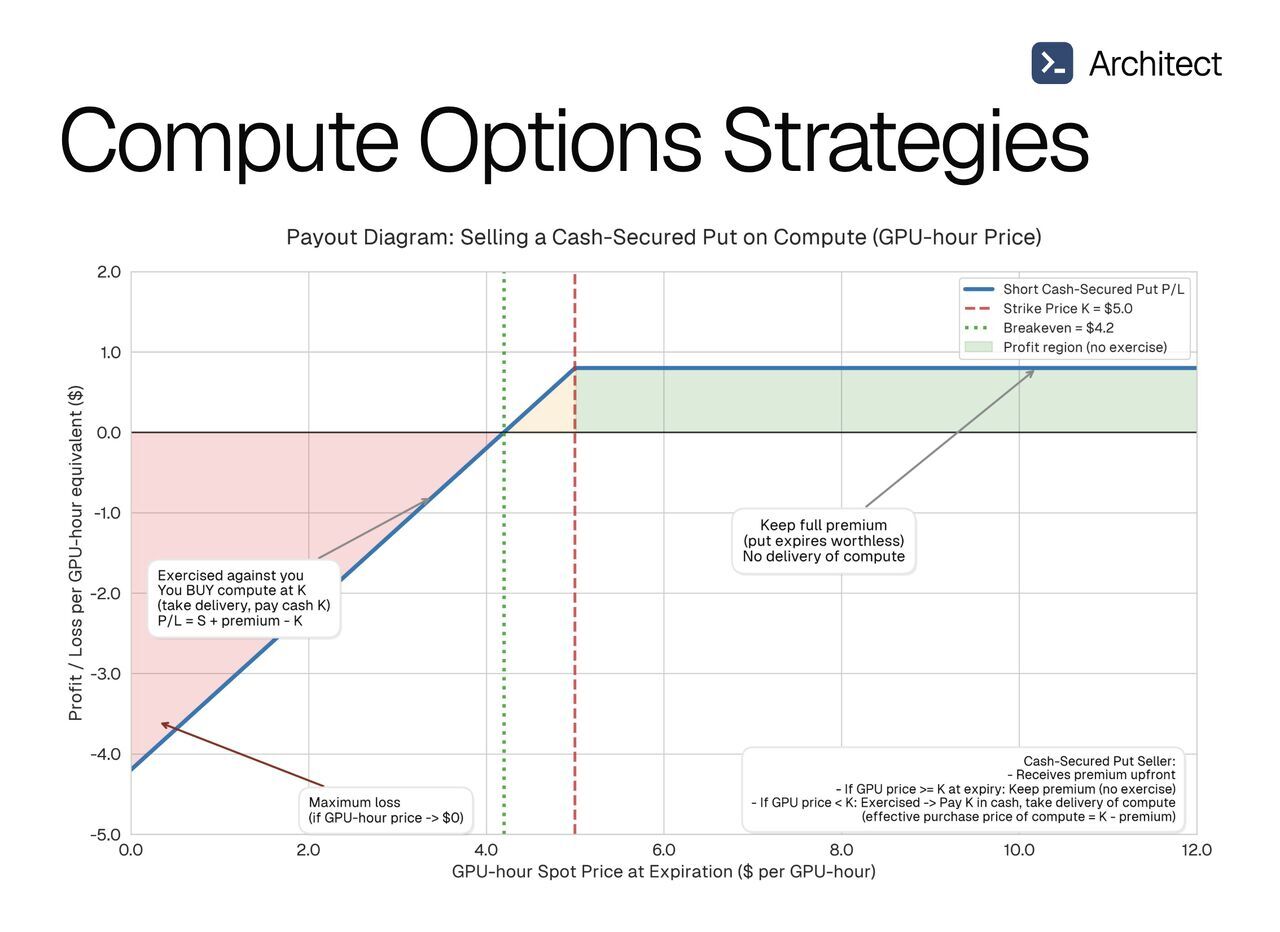
In this article we will go over two different options strategies known as a covered call and a cash-secured put. A covered call is an options strategy where you own the underlying asset and simultaneously sell a call option against the underlying instrument. A cash-secured put is an options strategy where you sell a put option while setting aside enough cash to buy the underlying instrument at the strike price if the option gets exercised.
Compute Sellers: Covered Calls
Compute sellers such as neoclouds are long inventory: racks of accelerators that will be rented out over the coming years. Against the capacity they already own, they can write covered calls on GPU-hour prices above today's market and collect the premium as income.
If prices stay flat or drift lower, they keep the premium as yield on top of their rental revenue. If prices rise above the strike price at expiration, they rent out capacity at the strike price while still keeping the premium. The upside beyond the strike is capped, but in return the seller converts a portion of future GPU price volatility into present cash. At each expiry, the seller can keep writing calls against inventory, harvesting premium from a depreciating asset.
Compute Buyers: Cash-Secured Puts
Compute buyers such as frontier model companies and AI labs are short inventory, looking to acquire rental time on GPUs. Buying futures locks in their effective price, and buying calls insures against rising prices. However, they can also write cash-secured puts, which is another important derivatives trading strategy for compute buyers.
If there's a price below the prevailing GPU rental rate that a buyer would be happy to pay, they can sell a put at that strike and immediately collect the premium as income. If prices rise, they keep the premium when the put expires out of the money. If prices fall to the strike or below, they effectively buy compute at the lower price, partially subsidized by the premium they collected.
Executed with discipline and proper risk management, both strategies may generate income while the worst case scenarios align with the natural hedge.
US Regulated AI Compute Derivatives Contracts
The AI Exchange is preparing to launch U.S. regulated Compute Futures, a derivatives contract that provides price transparency and risk management to companies with exposure to GPU price volatility. Modeled on the same market infrastructure as oil and gas, this is a landmark moment for the new compute markets. This new corner of finance is quietly taking shape at the intersection of artificial intelligence (AI) and commodities trading.
Based on a suite of compute indexes, Compute Futures enable the trading of GPU hours as a hedgeable commodity. Contracts offer quarterly, monthly, and yearly expirations priced on Nvidia H100 and H200 benchmarks.
Derivatives markets are regulated by the Commodity Futures Trading Commission (CFTC) and these strategies are hallmarks of mature markets. The AI Exchange and our industry partners are ready to support compute as a US regulated asset class from the start.
New to compute derivatives? Start with Compute Futures, or see a fully-worked hedging example in Cash-Settled Compute Futures.
Trade compute futures on AI Exchange
AI Exchange is the first CFTC-regulated venue for futures on compute costs and other AI supply-chain inputs — currently pending regulatory review.
Learn about AI ExchangeAmerican Innovation Exchange LLC ("AI Exchange") is registered with the Commodity Futures Trading Commission as a designated contract market, but is pre-operational. AI Exchange's intended products described herein will only be offered in compliance with all applicable law and regulations. This material is for informational purposes only and does not constitute an offer to buy or sell any financial instrument or a solicitation of any investment. Information is provided "as is" and any descriptions of planned products, features, or services are preliminary, subject to change without notice, and should not be relied upon as commitments regarding future availability, functionality, or performance. Trading futures involves substantial risk of loss and may not be suitable for all participants and may result in losses exceeding your initial investment amount. Leverage can amplify both gains and losses. Past performance is not indicative of future results. This material does not constitute investment, legal, tax, or regulatory advice. Recipients should conduct their own due diligence and consult qualified advisors before transacting. Not available where prohibited by law.